Gayton McKenzie accused of not understanding fashion industry after his meeting with Shein
Fashion designer David Tlale said he doesn’t think Gayton McKenzie understands the complexities of the clothing and textile industry.



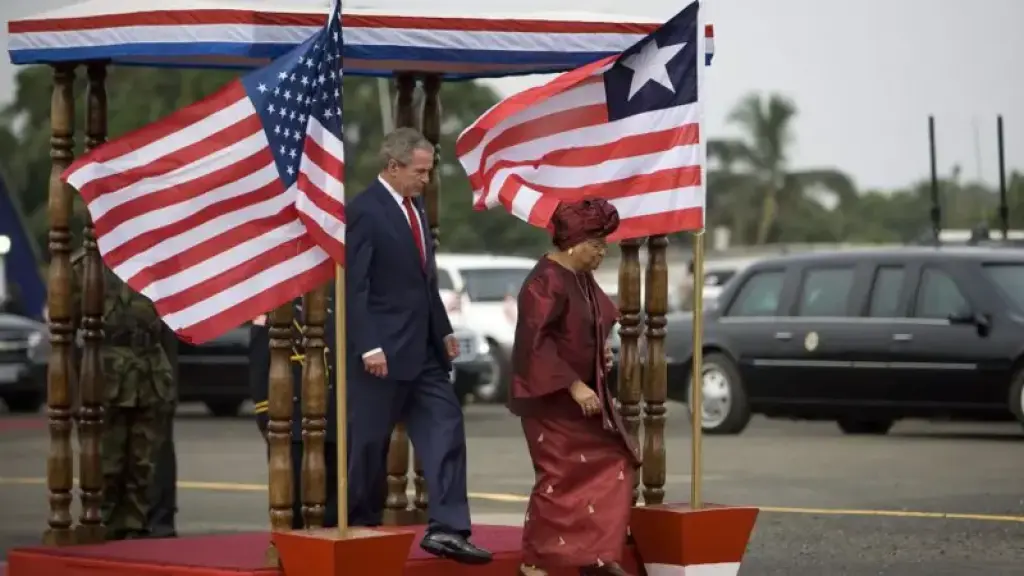
Relations between Washington and Monrovia have been complex throughout the African country's history.
When the first Black Americans landed on the west coast of Africa 200 years ago, they were following the reverse path of their ancestors, who had been forcibly removed from the African continent to be enslaved in the Americas for more than two centuries.
These pioneers, many of them newly freed from slavery and other freeborn children of enslaved people, established a colony on the site that would be called Liberia, or "land of the free."
They left behind the slave-based society of the United States, where they faced prejudice, inequality, and countless limitations, even after becoming free. In their new home, they sought to build a life with greater opportunities and political rights.
But the story of the creation of this country in Africa to house America's former slaves is complex.
While many free Black Americans had spearheaded the return-to-Africa movement decades earlier, the early colonization of what would become Liberia was encouraged and sponsored by an organization composed of white men, many of them slave owners.
Founded half a century before the abolition of slavery in the country, the ACS enjoyed the support of illustrious names, including then-President James Madison (1809-1817), former President Thomas Jefferson (1801-1809), and future Presidents James Monroe (1817-1825) and Andrew Jackson (1829-1837).
ACS members held diverse, and often contradictory, views regarding slavery.
Some were abolitionists and had a genuine desire to help the Black population build a better life in Africa. Others, however, rejected the idea of abolition and believed that free Black people should no longer live in the United States because they could endanger the institution of slavery.
Many slave owners at the time feared that the growing number of freedmen might foment rebellions among those still enslaved, and they tried to prevent them from living together. In some cases, slave owners even offered manumission on the condition that the newly freedmen agreed to move to Africa.
Other members of the ACS advocated the gradual end of slavery, but they also feared the effects of integration and rejected the idea that free blacks and whites could live side by side.
Despite this diversity of positions, ACS members agreed on a colonization project in Africa, which would establish a home for freed Black people to reduce the number of free Black people living in the United States.
The idea gained popularity and several state colonization societies soon began to emerge across the country, following the same model.
"Is it a racist organization? Is it anti-slavery? The answer is more complex," says Power-Greene, noting that the ACS has gone through several phases over the decades.
Back to Africa Movement
Although ACS was founded by white men, the Back to Africa movement was already popular among the Black population at the time. Even before the abolition of slavery, diverse communities of free Black Americans emerged across the country.
"It's in these communities that the activities of the back-to-Africa movement are taking place, these ideas are developing," historian Herbert Brewer, a professor at Morgan State University in Baltimore and an expert on the African diaspora, told the BBC.
"It's important to understand that the back-to-Africa movement predates the ACS," Brewer says. "As early as the 18th century, Black people in the United States were thinking and writing about various projects to repatriate people of African descent to Africa."
Some Black Americans believed they could only escape discrimination and enjoy a truly free and prosperous life by returning to Africa, the land of their ancestors. Many were proud of their African heritage.
"In the 1820s, the United States was a peculiar place for a free Black person," Brewer notes. "You were legally and technically free, but in reality, and based on the various types of laws that existed at the time, you were excluded from public life."