The Cape Winelands Airport has a rich history. It was built in 1943 to serve as an operational base for the South African Air Force.
It featured four runways and was home to Lockheed Ventura bombers during the tumultuous era of World War 2.
It was previously known as the Fisantekraal Airfield and belonged to the South African Air Force. However, it became privately owned in 1993.
In November 2020, private investors acquired the Cape Winelands Airport property. It is owned and operated by RSA.Aero.
Currently, Cape Winelands Airport serves as a general aviation facility and is a popular choice for flight training in the Cape Town vicinity.
It is located on a 150-hectare site 13 km northeast of Durbanville. It is, therefore, ideally situated to serve the Cape Town aviation sector.
Plans are underway to transform the Cape Winelands Airport into a hub for air travel to Cape Town, aiming to become an engine for regional economic development.
The airport has previously unveiled a R7 billion redevelopment and expansion plan to create an international commercial airport.
The first step is to expand and realign the primary runway to 3,500 m. The airport currently has four runways, two of which are inactive, and the others are 700 m and 900 m long.
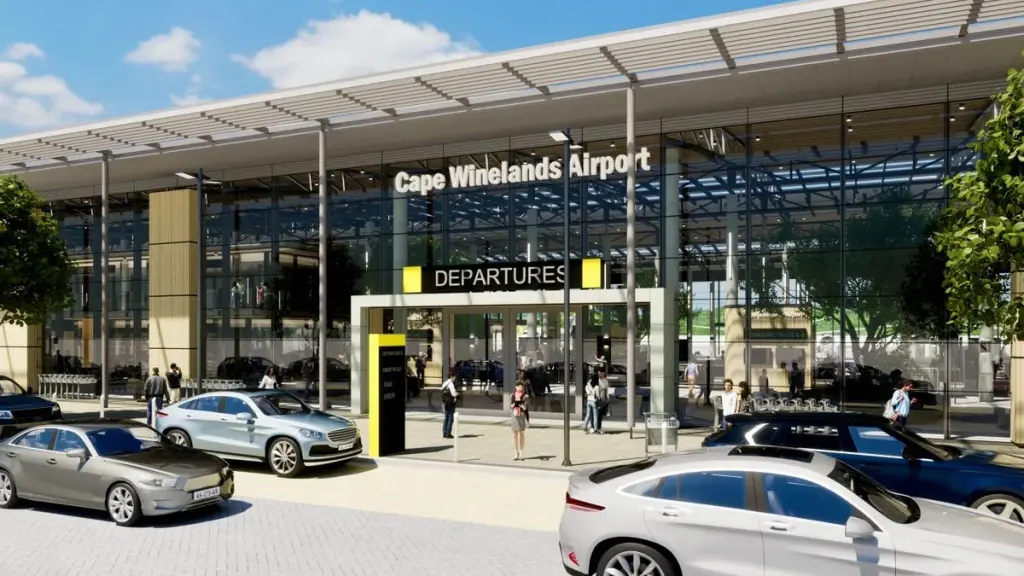
The Cape Winelands Airport will develop a new, boutique terminal building, including state-of-the-art processing facilities.
The terminal building will utilise the latest technology to provide modern solutions for check-in, baggage handling, and security.
The cargo facility is another key part of the development. The success of airline operations is directly linked to their ability to fill the aircraft’s belly.
A cargo processing facility that will be built with ease of access to the airside, ensuring that operations can be streamlined.
The airport is also investing in new hangarage, which includes additional hangars needed to serve the general aviation, business aviation and airline sectors.
There will also be an upgrade to the fuelling facilities. Aviation fuel storage comprising JetA1 and Avgas will be included, with special spatial allocation for sustainable aviation fuels (SAFs).
A fuelling station is expected to be built at the entrance to the airport. As is typically seen globally, they service airport users, as well as individuals in proximity to the airport.
The Cape Winelands Airport plan also includes hotel accommodation for passengers and flight students, a heliport, warehousing, and logistics facilities.
The Cape Winelands Airport

The Cape Winelands Airport was an active participant in the recent South African Tourism Investment Summit.
As part of the event, it hosted delegates at the airport, offering them first-hand insights into the development.
“Positioned at the intersection of tourism, agri-business, aviation training, logistics and more, Cape Winelands Airport is designed to be far more than an aviation hub,” it said.
“It represents a gateway for economic transformation, including creating jobs, strengthening supply chains, and unlocking new visitor experiences in Cape Town.”
“By aligning infrastructure development with national tourism ambitions, Cape Winelands Airport is contributing to the creation of an investment-ready environment.”
The Cape Winelands Airport also attended Routes World 2025 in Hong Kong, a gathering at the heart of global air service development.
At this event, the Cape Winelands Airport team engaged with airlines, airports, and industry leaders from around the world.
These engagements formed part of a plan to connect the Cape Winelands and South Africa with the world, driving investment and growth in the region.
Mark Wilkinson, Director of the Cape Winelands Airport, said that giving Cape Town a second airport will ease congestion and reduce carbon emissions.
He said they hope to start construction on the Cape Winelands Airport upgrade next year and be operational by 2028 with the first phase of operations.
“It is going to transform the economic landscape of Cape Town and the Western Cape,” Wilkinson said at Africa’s Green Economy Summit.
“It has some incredible features, and it addresses many capacity constraints and unlocks latent growth for the existing demand.”
Wilkinson said this infrastructure project will have the single most significant impact from a socioeconomic perspective than any other project in Cape at the moment.
Raising between R8 billion and R10 billion for the Cape Winelands Airport

Wilkinson said they are raising between R8 billion and R10 billion for the Cape Winelands Airport project, with a split between debt and equity.
“We’re currently undergoing a capital raising process. We are a private organisation and are currently privately funded,” he said.
He explained that these projects require significant capital, as they are very capital-intensive, with extensive earthworks and civil works required.
“We hope to receive a positive record of decision regarding our environmental impact assessment and expect to commence the construction next year,” he said.
“So, at the moment, we’re engaging with infrastructure funds, banks, impact funds, private equity operators, and wealthy individuals.”
He explained that they are a South African team, which is very patriotic and proud of what they’re doing.
“We’re honoured to be involved in an airport development that doesn’t happen very often. We’ve got a fantastic team, and we’re fortunate to have the right people in the room,” he said.
The Cape Winelands Airport aims to follow the examples of the Lanseria Airport in Gauteng and the Kruger-Mpumalanga Airport in Nelspruit.
“Both are very well run, and they’re very successful. We share many similarities with these airports,” he said.
“Additionally, having a second airport in Cape Town benefits everyone. It will keep Cape Town International on its toes.”
“Likewise, they will keep us on our toes to make sure we are delivering the best products and service, which is the same for all industries.”
Cape Winelands Airport images


Issued on BusinessTech by Staff Writer | https://businesstech.co.za/news/property/838454/new-international-airport-in-cape-town-on-its-way/